
Last updated on November 22nd, 2025 at 09:01 pm
What’s better than a cheaper Lightroom alternative? A free one. Continue reading my Darktable review to see how it holds up.
Darktable is open-source photography software that is free to download with no premium upgrades. It’s an image-management software, also known as a DAM (digital asset manager), that edits JPG and RAW files.
I like this photography software because it’s available on different operating systems than the usual Windows apocalypse or the cash-grabbing macOS. Some of the included OSs are Fedora, Solaris, and Ubuntu.
On the other hand, most photographers and most people, in general, use Windows or macOS. So, I’m going to review Darktable on my MacBook Pro. Sigh.
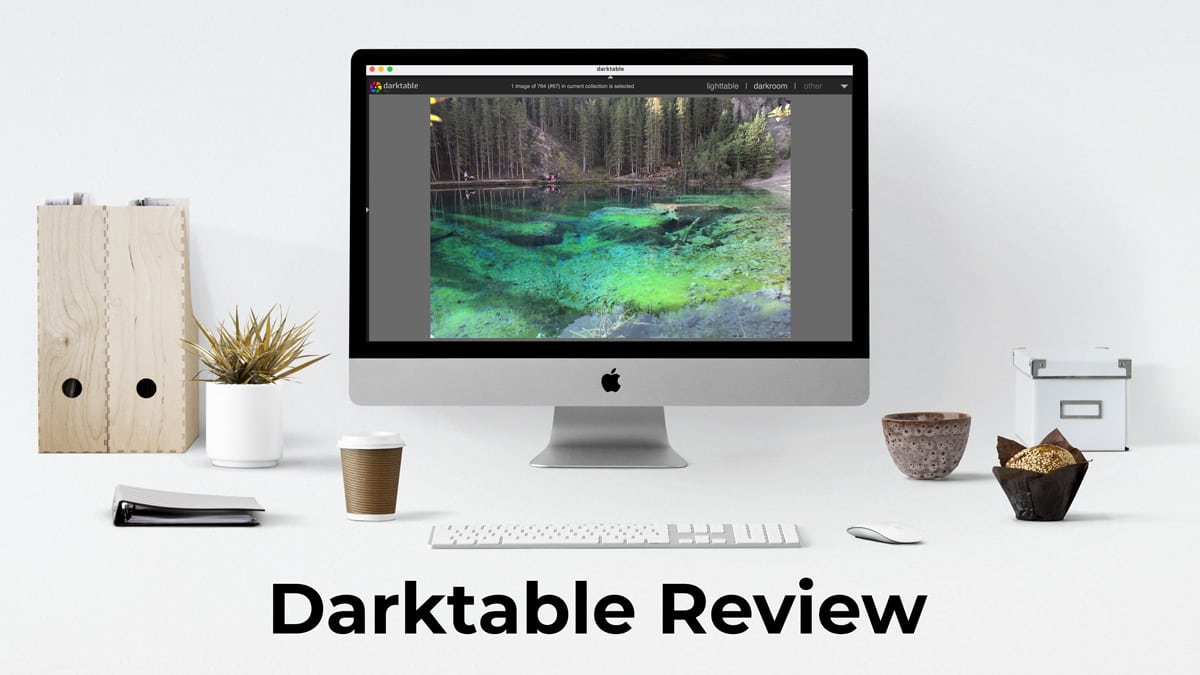
Darktable Review
This review focuses on how Darktable handles daily photography tasks, including organizing an image collection, adjusting light & color, removing minor imperfections, and exporting final results.
I will sprinkle in a bit of personal perspective here and there, but the bigger picture is what matters most: a close look at how well Darktable manages to function as a dependable digital darkroom.
Interface

Darktable’s interface, which is divided into modules, represents both its strength and its source of initial confusion. It has a Lighttable component for sorting and rating photos and a Darkroom component for deep editing and development. The idea is straightforward in theory: one place to manage all your thumbnails, then another spot to fine-tune each image.
However, the layout can feel cluttered until you memorize the location of essential controls. There are collapsible side panels with a variety of adjustments, including exposure, contrast, white balance, and more nuanced modules for color zones or tone mapping.
One attraction is the capacity to stack multiple edits without damaging the original file because Darktable works non-destructively, storing changes in a separate sidecar.
Because Darktable supports a broad array of RAW files, it accommodates many camera brands. The internal processing pipeline is designed to preserve detail and maintain accurate color profiles, which might be a boon for photographers who care deeply about controlling color shifts or want to push highlights further.
The software’s color management can also apply different working profiles, so advanced users get the freedom to choose. This is especially handy for those who need consistent color from camera to final output.
I tested it on RAW images from a Canon 6D model and found the results to be quite crisp, though getting everything right can require repeated tinkering.
Organizing files is less flashy but remains necessary. Darktable includes features like tagging, star ratings, and keywords, which help you search for images later. The approach is reminiscent of other photo libraries, so if you’ve used another catalog-based editor, you might find some aspects of the Lighttable familiar.
Within the Darkroom module, you can adjust brightness, pull back blown-out highlights, correct lens distortions, or get fancy with local adjustments through masks.
Darktable also offers a retouch feature to remove small distractions. I discovered it is not as simple to master as the healing tool in specific premium software, yet it can accomplish a similar result with enough practice. There’s also a liquify option that, while not geared for major manipulations, can handle modest shape corrections.
All these capabilities work on Windows, macOS, and Linux, which is particularly remarkable. Many free photography programs don’t always cater to multiple operating systems, but Darktable aims to remain a cross-platform resource, allowing a broader audience to use it without being tied to one machine type.
Learning Curve

Darktable can feel strangely complex in day-to-day use. Beginners might stare at the modules and wonder which slider to tweak first. I recall being baffled during my first attempts, especially when I’d open the Darkroom panel and see an entire stack of modules that seemed to overlap in purpose. The vast selection of tools can prompt repeated trial and error, which may frustrate anyone who expects immediate clarity.
That said, after exploring menus for a while and absorbing some community tutorials, I gained more confidence. The software has references scattered online, and these guides cover topics from advanced masking to color correction.
The official manual adds further detail, though it can be dense. Because of the steep learning curve, it might take longer to master Darktable than you’d expect if you’ve used DxO PhotoLab or ON1 Photo RAW. The payoff is that once you do grasp how each module behaves, the editing possibilities become quite broad. That long road can be worth it if you plan to stick with a cost-free editor without monthly payments like you do with the Adobe Photography Plan.

Performance
Darktable’s performance varies depending on how powerful your machine is and how many images you edit at once. While it can handle large batches of RAW files, you might experience a slowdown if you stack multiple complex modules on top of each other.
Applying noise reduction, lens corrections, and multiple color adjustments all at the same time can introduce brief lags, especially on older hardware.
I tried editing and exporting a few dozen high-resolution files on a higher-end MacBook Pro with the Apple Silicon chip, and it performed well. The application can benefit from a decent CPU and enough RAM to manage heavy tasks. Darktable does incorporate options for GPU acceleration, which might improve performance on select setups.
On the stability front, I didn’t notice any frequent glitches or abrupt shutdowns in my sessions. Others have reported the occasional hiccup with certain camera file formats, but these issues tend to be addressed in subsequent releases. That sense of community-based development means you can often see improvements in updated versions.
Darktable Pros and Cons
Darktable’s strongest point is its open-source nature. You can download and use it without cost, and there are no hidden subscriptions. It offers deep editing modules that can rival pricier software with continuous input from a global development team.
If you like being part of something that grows organically, Darktable fits that preference. It also has a committed user community, which can be helpful if you have questions about unusual editing needs.
However, there is no denying that Darktable takes extra time to master.
Beginners might find it less intuitive than commercial platforms. There are also fewer presets readily available, so if you rely on quick templates, you may be disappointed. Another point to note is that certain systems or video cards can introduce glitches, which may force you to try alternate settings. It’s not easy to know if you will run into one of those issues, but it does happen for a minority of users.
Who Should Use Darktable?
Hobbyists or casual photographers who are mindful of money could gravitate toward Darktable. The zero cost is unbeatable, and the only real investment is your energy and patience. Those who simply want to experiment with RAW images and learn about color or contrast adjustments can appreciate the freedom Darktable provides.
Professionals with a thirst for ultimate control might also become devoted supporters, given the software’s advanced modules. Still, they may hesitate if they need something that just works right away. I have seen some folks transition to Darktable to avoid recurring costs, and they say the savings are helpful in the long run. Students on a tight budget might discover a suitable editing companion, provided they are willing to brave the steep learning curve.
If I was a professional photographer with clients, I personally would stick with premium photography software like Lightroom Classic or Capture One. The time savings are just too valuable for me.
Final Thoughts
Darktable can feel quite bewildering at first, and it’s plainly not as intuitive as DxO PhotoLab or ON1 Photo RAW. I remember trying to find a basic exposure slider and accidentally stumbling across advanced color manipulation tools.
Once that initial hurdle is crossed, though, Darktable transforms into a capable digital darkroom with an array of features that are on par with commercial programs. It can handle everything from fundamental tonal adjustments to complicated local corrections, all wrapped in a non-destructive workflow that preserves your originals.
Anyone contemplating a move away from paid subscriptions or strict licensing might find Darktable reasonable. The time spent learning might be significant, yet the cost savings can be worthwhile for casual users and budget-conscious enthusiasts.
In the end, Darktable’s best attribute is that it grants you professional-level editing at zero cost, provided you can handle the frustration of figuring out where everything is. If you can afford it and have Windows or macOS, premium photography software will save you time and help you create more aesthetic photos.
Darktable

Darktable is an open-source photography software that is a free alternative to Lightroom. You can manage and edit images. Read the complete Darktable review.
Operating System: Linux, MacOS, Windows
Application Category: Photography
Darktable takes some getting used to, for sure. It works as well or better in places than Lightroom (I have both and more). It’s not much more ‘clunky’ than any of the others, you’re just not used to it. The issue I have with Darktable is how it handles the ‘collections’ (‘library’ for LR users). Other than that, it’s very good. I’ve gotten really great results with it.
No other software will do anything ‘more aesthetic’. That’s just ridiculous.