

Bottom Line (TL;DR): For about the cost of a quick dinner, the K&F Concept Macro Lens adds a new dimension to the Osmo Pocket 3. It won’t replace a full-frame macro setup, but it opens the door to close-up work without blowing your budget. Be patient. Keep the gimbal steady. Expect trial and error. But when it works, it gives you something fresh without asking for much.
Think of the K&F Concept macro lens as a pocket-sized magnifier that lets your Osmo Pocket 3 explore a world usually hidden to the naked eye.
It gives you access to tight, intimate shots the base lens can’t touch. Quick spoiler, though—focusing with this lens is frustratingly difficult. Even the steadiest hands will struggle with camera shake, so you’ll need patience.
Why Macro on a Pocket 3 Gimbal Camera Even Matters
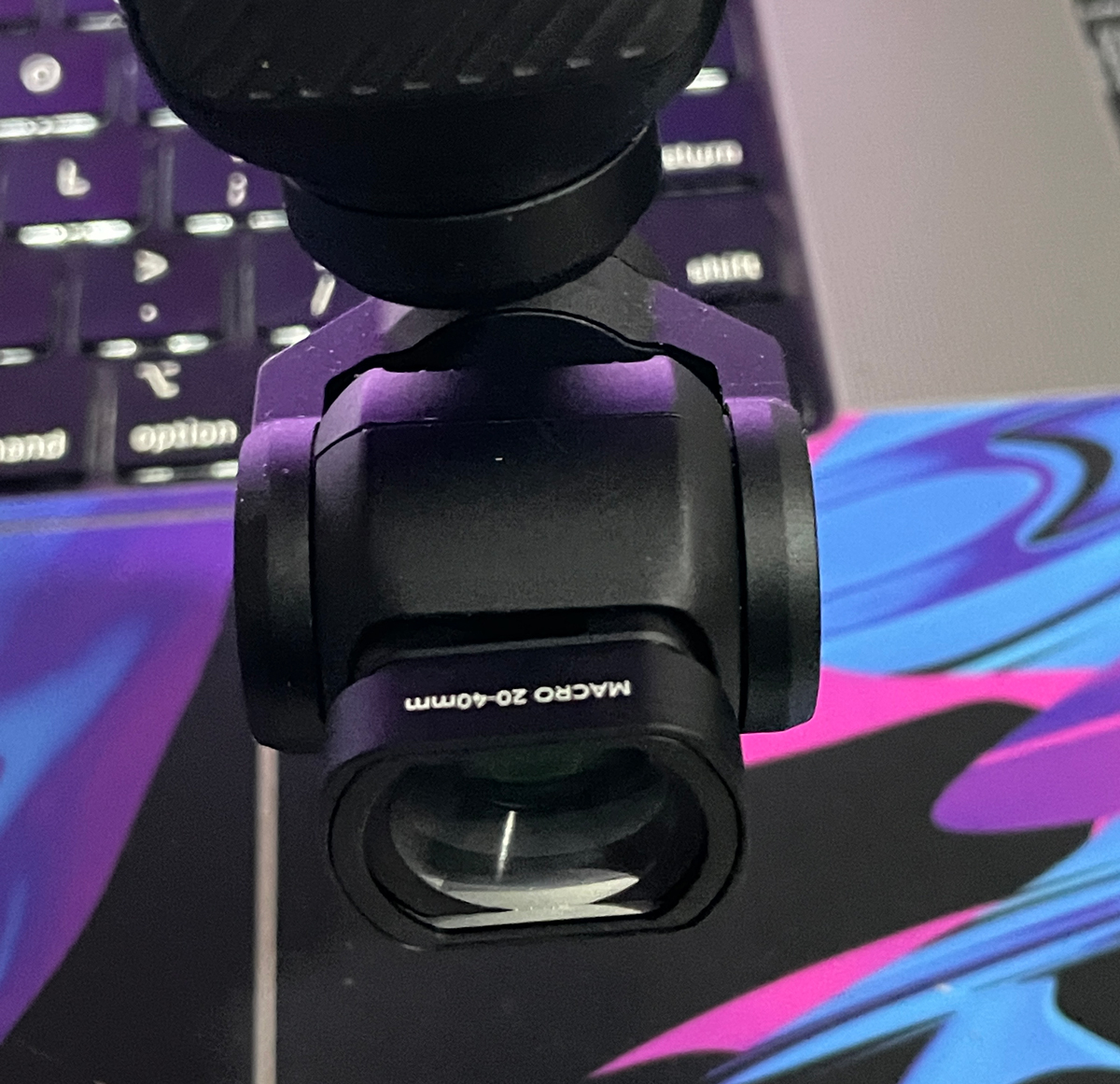
The standard Osmo Pocket 3 can’t focus on anything closer than about 20 cm. However, once you attach the macro filter, your working distance drops to around 2 to 4 cm. That change opens up creative doors.
You can shoot the veins of a leaf, the texture of a coin, or the brush hairs on a makeup brush. It’s a compelling way to add storytelling shots to travel vlogs, tech reviews, or casual B-roll.
But there are boundaries. The lens has a fixed f/1.7 aperture, which leaves very little depth of field. Combine that with motion and camera shake becomes a challenge. Lighting can also be tricky since you’re working so close that shadows easily creep in.
Specs at a Glance

Magnification sits at 10x. You’re able to fill the frame with details invisible at normal distances. The sweet spot for sharpness lies between 20 mm and 40 mm. The coatings help repel fingerprints and reduce glare.
The magnetic attachment is simple. No twisting or screwing involved. The main issue is that when you shut the camera off, the lens has to come off. Otherwise, the Osmo Pocket 3 won’t fold into its resting position. This became annoying fast.
Field Test Shoot-Day
I visited the Botanical Garden in Medellín, Colombia, to test the Kentfaith macro and DJI OP3 combo.
I found the K&F Concept macro lens filter great in theory; however, in real-life situations, the bokeh or shallow depth of field made it difficult to keep subjects in focus. Any spread along a 3D axis made parts of a subject blurry. Even when the insect stayed still, my hands didn’t.
Take a look at the spider (arachnid) below. Notice how the back body of the spider is in focus; however, its head is not. This is a common problem due to the aperture of the Pocket 3.

It was even harder to keep the Pocket 3 steady and the subject in focus when I pressed the screen to choose the subject to focus on.
Image-Quality Breakdown
Sharpness is not outstanding, and the images I took with the K&F Concept macro lens and Pocket 3 were on the soft side. I needed to add post-sharpening in Lightroom Classic or Topaz Photo AI to recover edge sharpening and detail.
Don’t expect professional results that you would get with a full-frame camera system and macro lens. The sharpness and closeness are just not there. You’re not going to be able to photograph or record the multiple eyes of a spider. But, considering the size and price, it still performs reasonably well.
Personally, I think the K&F Concept Macro Filter is fun to play with and experiment with using the DJI Osmo Pocket 3. However, it doesn’t easily produce professional shots instantly; you’ll need some patience and maybe even a tripod or Gorillapod.
The little bugger below took several attempts to get in focus with photo mode. Notice how I can’t get any closer to photographing its head without losing sharpness or pixels. By the way, this is the cropped version of the photo.

I also noticed something strange during my walks. While I was walking around with the macro lens attached and the Pocket 3 powered on, the continuous focus was still active, and the Pocket 3 kept vibrating. I wasn’t sure if this was a glitch or if the Pocket 3 was trying to shake off lens dust and focus. When I use the Pocket 3 without the macro lens, it never vibrates. A firmware bug? Maybe.
Compared to Freewell and DJI’s own macro filters, K&F wins on price. Optical clarity seems close enough that most casual users won’t notice a difference.
The K&F Concept Macro Lens is enormous relative to other filters, and it wasn’t convenient for me when you shut off the Pocket 3 since it can’t go into its power-off position with the macro lens attached, making most Pocket 3 cases useless.
It was nearly impossible to get this caterpillar’s head in focus while it was slowly moving around and eating the flower petals. Photographing flowers would be much easier than photographing insects with the K&F macro lens filter.

Who Should (and Shouldn’t) Buy It
Though the K&F Concept Macro Lens and Pocket 3 combination has flaws, at least you don’t have to pay $500 or more for a professional macro lens, and it’s a great introduction to macro photography.
If you’re a travel vlogger looking to mix in cutaway shots or a reviewer needing texture close-ups, it’s a solid pick. It also suits educators or hobbyists who want to shoot small objects. But if you rarely shoot closer than arm’s length or require stacked-focus images, skip it.